

AI Is Not the Future — It Is the Present for Chartered Accountants
Home
AI Is Not the Future — It Is the Present for Chartered Accountants

AI Is Not the Future — It Is the Present for Chartered Accountants
The revolution in chartered accounting brought about by artificial intelligence is happening now, not in the distant future. By 2025, AI will have evolved from an experimental idea to an operational reality that is integrated into audit firms, compliance procedures, and advisory services.

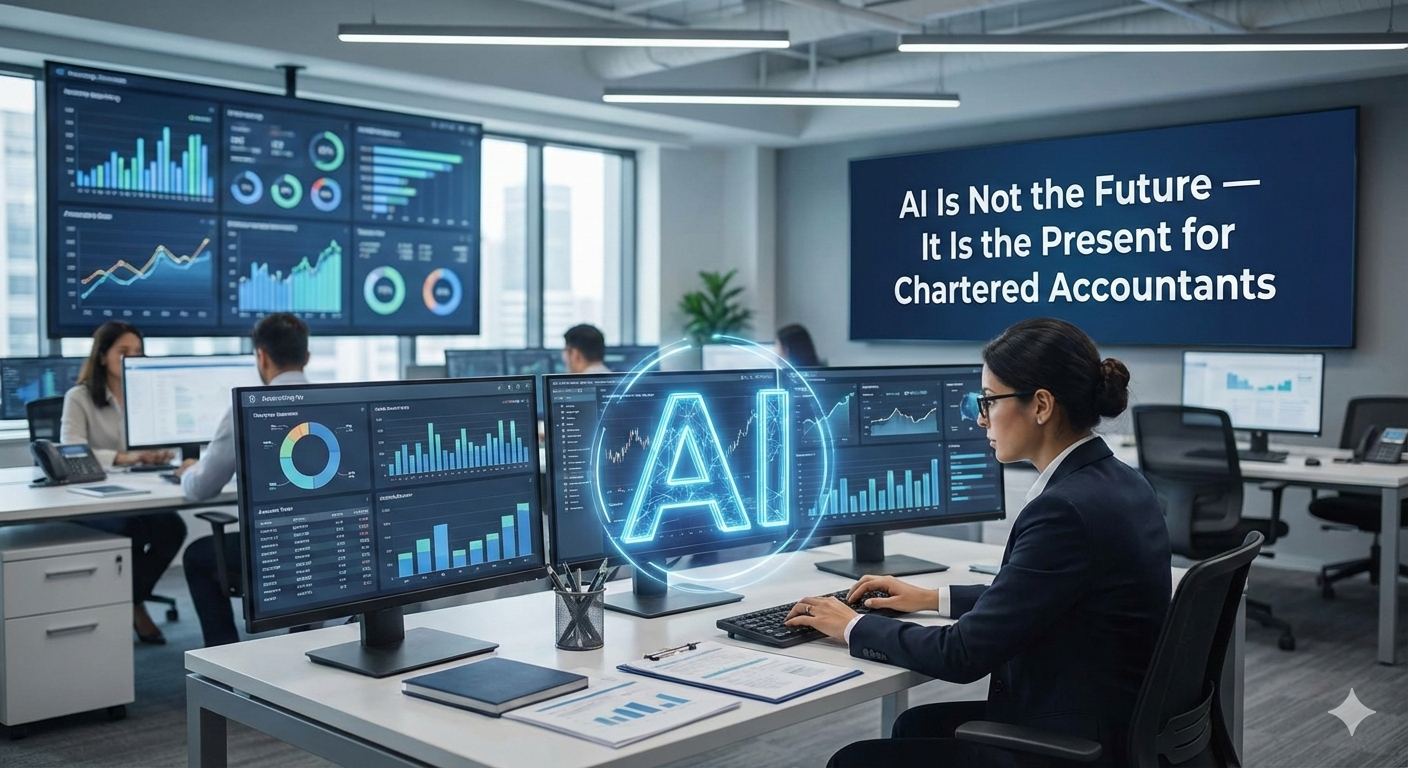
The revolution in chartered accounting brought about by artificial intelligence is happening now, not in the distant future. By 2025, AI will have evolved from an experimental idea to an operational reality that is integrated into audit firms, compliance procedures, and advisory services. Today's Chartered Accountants (CAs) must embrace AI's transformative potential in real-time, incorporating it into their daily workflows and developing the skills necessary to lead in this new era, rather than waiting for the future.
From Compliance Officer to Strategic Advisor : The chartered accountant's traditional function as a compliance officer has completely changed. Accountants are being freed from monotonous, transactional work and elevated to positions of strategic influence by AI, not being replaced.
For many years, manual data entry, invoice reconciliation, auditing and tax computations have accounted for the majority of CAs' billable hours. These fundamental tasks are being methodically automated by AI, giving CAs a previously unheard-of chance to refocus their expertise on tasks requiring human judgment and strategic thinking.
The occupation is escalating along the value chain with those using AI differentiated and positioned as trusted business advisors while the holdouts risk being relegated to commodities. The accounting firms using AI report expending efforts on enhanced client service and risk management in contrast to data entry.
The Practical Reality: AI Applications in Core CA Functions:
1. Audit Transformation Through Intelligent Automation
With the use of AI, auditing is undergoing a significant change from sample-based, periodic reviews to continuous, real-time auditing. AI allows for 100% data coverage, swiftly examining entire transaction sets to find anomalies, in contrast to conventional techniques that test only 2-3% of transactions. By spotting questionable transactions, vendor irregularities, and round-tripping based on past trends, sophisticated algorithms improve fraud detection. In order to improve accountability, accuracy, and transparency in financial investigations, ICAI has also aligned its forensic and auditing standards with the application of AI.
2. GST Compliance: Reducing Error, Accelerating Accuracy
High volumes and complicated regulations make GST compliance a constant struggle for Indian chartered accountants, but AI is gradually reducing these difficulties. By comparing purchase and sales data with GST returns, intelligent platforms now automate invoice reconciliation, saving over 70% of manual labor. While AI-driven proactive alerts track deadlines and transactional anomalies in real time, preventing late filings, mismatches, and regulatory notices, OCR-enabled tools precisely extract data from scanned invoices and PDFs, removing manual entry and transcription errors.
3. Tax Compliance and Filing
The implementation of digital changes and the 2025 Income tax Bill has greatly impacted the movement towards an AI-driven tax ecosystem. AI systems can now predict, and accurately identify TDS, and can also compute advance taxes and assess scrutinized bank transactions with reported income. This multifaceted intelligent approach has improved TDS prediction, streamlined filing, reduced error margins, and shortened filing time. Moving from compliance to proactive guidance has allowed CAs to reshape tax planning and provide valuable insight to their clients.
The Micro-Infrastructure: Tools and Platforms : The democratization of AI has enabled Chartered Accountants across firms of all sizes to access enterprise-grade capabilities. Cloud platforms such as Zoho Books, QuickBooks, and Tally Prime now embed AI for intelligent categorization and automated reconciliation, while generative AI tools like ChatGPT and Microsoft Copilotsupport drafting professional correspondence, summarising case laws, and tracking regulatory amendments. In addition, specialized AI agents from platforms such as Akira AI and Silverfin provide domain-focused support in areas like audit risk assessment and GST compliance, significantly enhancing efficiency and decision-making.
The Skills Gap and Upskilling Imperative: Despite the clear benefits of AI, a significant skills gap persists across the profession. Research by Chartered Accountants Worldwide indicates that while younger professionals are increasingly adopting AI tools, many firms still lack structured training frameworks. To bridge this gap, CAs must build strong AI literacy to understand capabilities and limitations, develop data interpretation skills to critically evaluate AI-generated insights with professional skepticism, and strengthen ethical reasoning to responsibly address concerns around algorithmic bias, confidentiality, and data privacy.
Ethical Challenges and Governance : AI integration is not without risk. CAs must navigate the "Black Box" problem—where AI decisions are difficult to interpret—and ensure Algorithmic Accountability.
Human-in-the-loop: The fundamental ethical principle is that AI augments human expertise but does not replace it. CAs remain ultimately responsible for audit opinions and tax advice.
Data Privacy: Protecting client financial data from breaches or unauthorized use by AI vendors is paramount.
Conclusion: The Competitive Imperative:
The evidence is clear: AI is not a future consideration for Chartered Accountants—it is a present necessity. Within the next 12 months, AI adoption will move from being a competitive advantage to a basic expectation, and within three years, the profession will likely divide between premium advisory firms that effectively leverage AI and compliance-focused practices facing intense margin pressure. The CAs who thrive will be those who adopt AI proactively while upholding strong ethical standards, shifting their role from data processing to data interpretation and reinforcing their position as trusted strategic partners in the modern economy.
Share this post: